Cycling: Fueling on Effort, Not Miles: Eating Strategy for Wind
Wind doesn't just slow you down, it changes how hard your body works. Learn to time your eating and fueling around actual effort, not preset distances.
You planned to eat at kilometre 40. The wind had other ideas. What looked like a comfortable four hour ride on the map turned into a grind into a headwind, and now you are hungry, low on energy and still 60 km from home. This is the real problem with a fixed fuelling plan. It ignores the wind. Your fuelling for a windy ride needs to match the actual effort, not the route profile or your original timeline. Let's see the fueling strategy for wind in cycling.
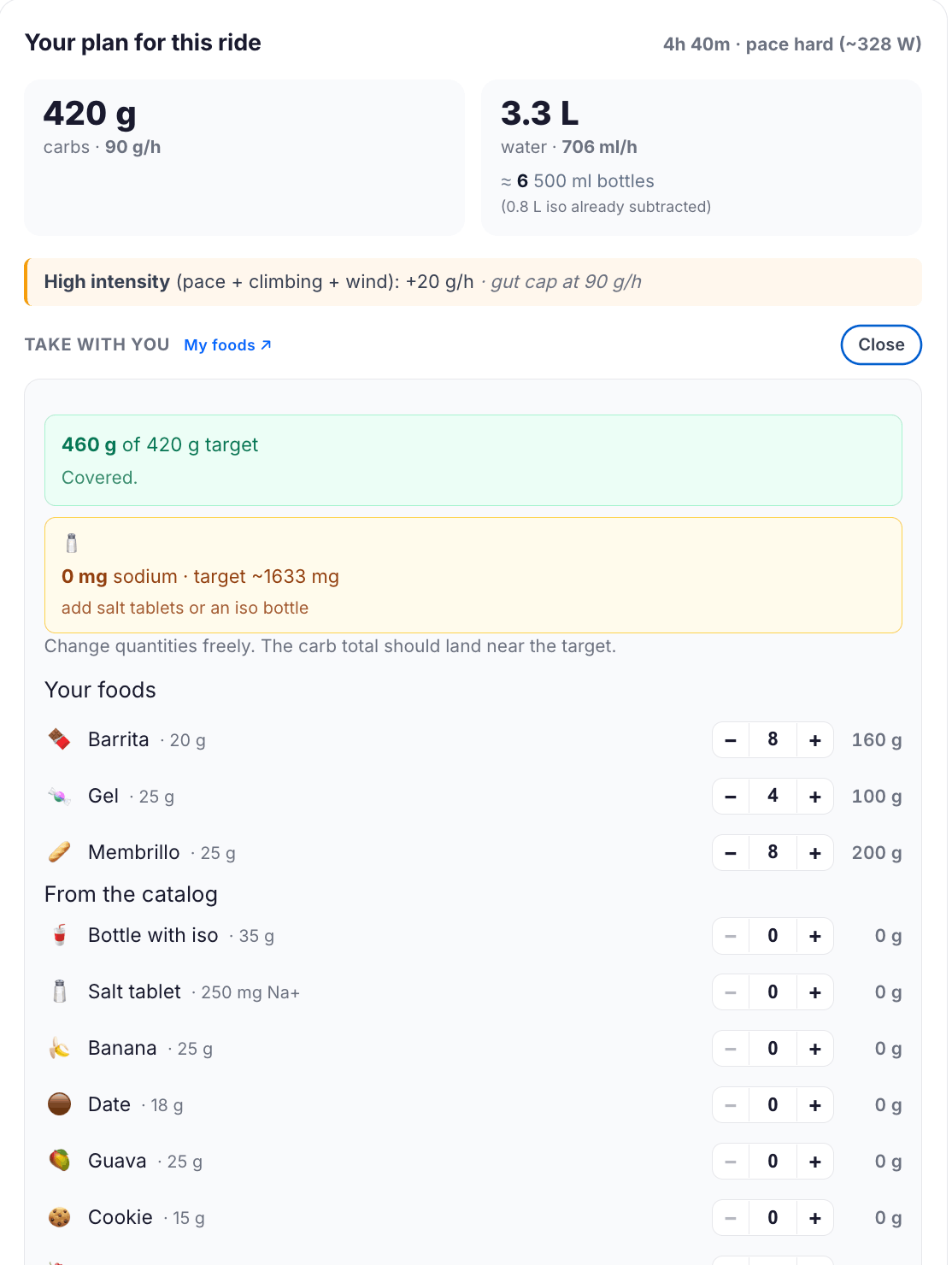
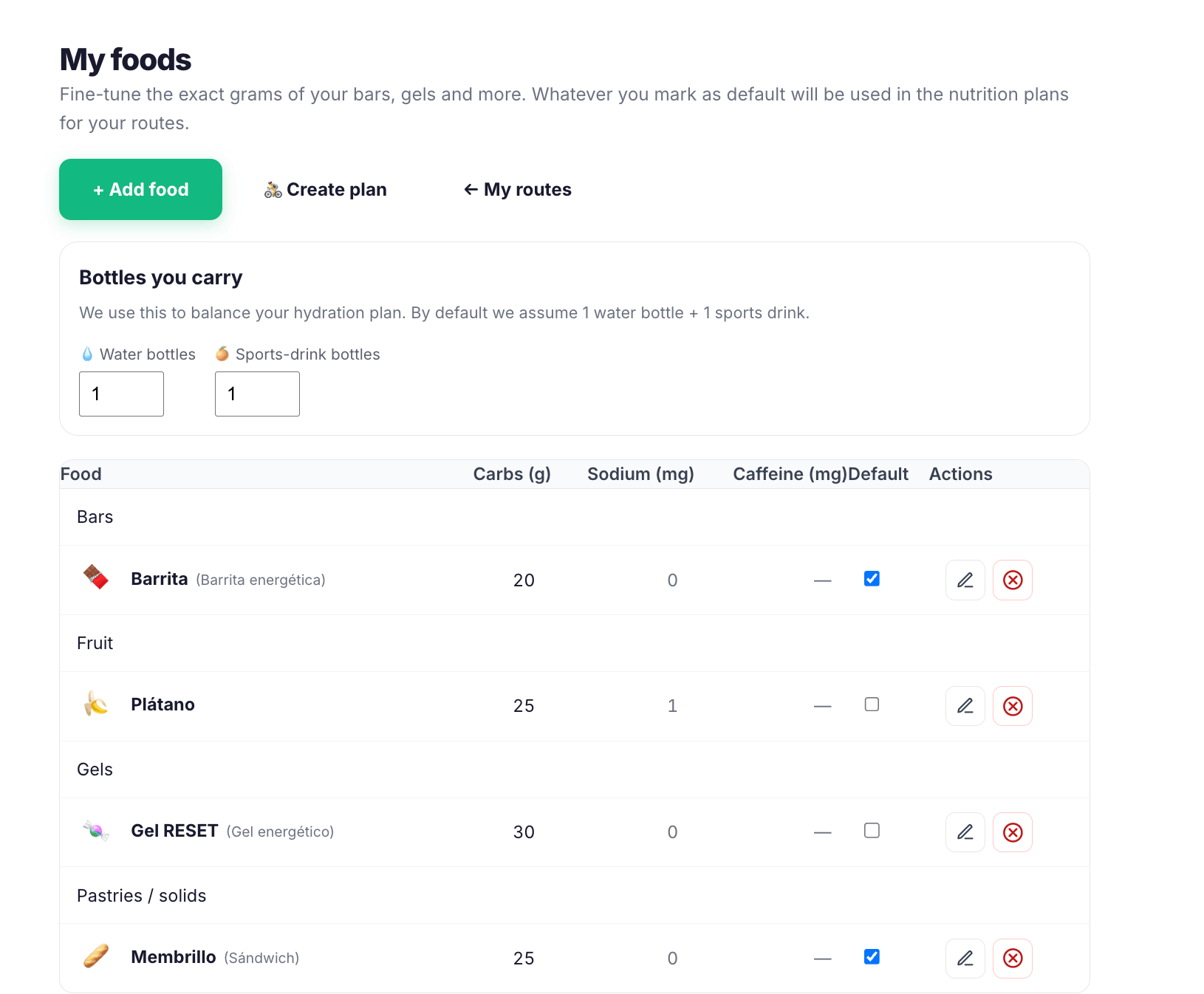
Get an exact nutrition plan for your next ride, free.
Build your plan in Bidón →Why Wind Breaks Your Nutrition Plan
When cyclists plan a ride, they usually set their feeds by distance or time. "I will eat at 40 km, then at 80 km." Simple, but flawed, because it treats a flat 40 km into a headwind the same as a flat 40 km with a tailwind. In reality you burn 20 to 40% more calories fighting a strong headwind, and your glycogen tank empties faster.
A headwind does not just feel harder, it is harder. Your body does not count kilometres, it feels effort. Heart rate, power and how hard it feels are what drain your fuel. When you are pushing 350 watts into the wind instead of the 220 you planned, your carbohydrate stores run down much faster. By the time you reach kilometre 40 you are already more depleted than expected, and your preset plan is out of step with what your body actually needs.
Wind also hides the problem. A strong tailwind on the first half of a loop feels easy and fast. Riders often eat too little there, thinking they are having a great day. Then they turn into the headwind, already low on glycogen, and the second half becomes a survival job. Wind hits your effort sharply, not in a straight line, and your nutrition plan has to account for that.
Effort Based Fuelling, the Real Framework
Instead of eating by distance, eat by effort. There are three ways to read your effort in real time.
- Heart rate. If your threshold is 175 bpm and you are holding 160, you are in tempo. If the wind pushes you to 170 for the same pace, your body is working harder and you need to fuel sooner.
- Power, if you run a power meter. This is the clearest signal. If your plan assumed 220 watts and the wind has you at 280, you are burning fuel at a different rate. Adjust your feeds.
- How it feels. Be honest with yourself. If the ride feels clearly harder than expected, your needs have changed. Do not stick to the plan out of stubbornness.
The rule is simple. When the effort goes up, fuel sooner. Do not wait for kilometre 40 if kilometre 35 already has you working at 80% of your max.
The catch is that mid ride, tired, with a climb coming up, it is hard to make that call well. This is exactly what Bidón is for. The Garmin data field takes the wind and route data from MoguWind Plan and sends you automatic nutrition alerts at the right moments, worked out from the real effort your route's wind demands, not just the clock or the distance. You stop guessing and start executing.
Free on Garmin Edge. Bidón tells you when to eat and drink in real time, worked out from your effort.
Get Bidón for Garmin →Real Time Wind and Calorie Burn
Headwind resistance rises sharply with speed. A 15 km/h headwind at 25 km/h ground speed adds roughly 20 to 25% to the power you need. A 25 km/h headwind can add 40% or more. That feeds straight into how fast you burn carbohydrate.
On a typical four hour road ride at a moderate pace you might burn 2,000 to 2,400 calories. Add a steady headwind over 15 km/h and that can jump to 2,400 to 3,000 or more. Your usual 250 calorie bar every 90 minutes may not be enough. You might need to fuel every 60 minutes, or reach for energy bars and gels that are bigger or more calorie-dense.
MoguWind Plan shows the wind speed and direction at each kilometre of your route. If you can see a 20 km/h headwind section coming at hour two, you know to fuel harder before and during it. That changes when you eat, not just how much. That difference matters more than most riders think.
How to Adjust on the Fly
Before the ride. Check the wind on your route segment by segment, not as one average. The time of day shifts the wind a lot. If the first 30 km are into a stiff morning headwind, plan to fuel earlier and more often there. If the wind builds in the afternoon, the back half of a long-distance cycling loop will cost more than the way out.
During the ride. Watch your energy, not your watch. A bonk is not about time, it is about glycogen. Signs you should eat sooner than planned.
- Your heart rate creeps up while your pace stays the same, a sign of building fatigue.
- Your legs feel heavier or less lively than earlier on.
- Your cadence drops even though you are trying to hold it.
- You struggle to hold your pace on a climb that felt easy 30 minutes ago.
If any of these show up, eat 15 to 30 minutes earlier than planned. Your body is telling you it needs fuel now, not in 20 km.
Wind and Hydration, the Forgotten Link
More effort also means more sweat. Riding into a headwind often feels cooler, which fools you into drinking less. But you are working harder and losing more fluid. Dehydration makes the bonk worse. Your blood volume drops, your heart works harder to move oxygen, and getting glycogen to the muscles becomes less efficient.
If the wind is keeping your effort high, drink 10 to 20% more. A simple rule. If you are breathing harder, drink more. Your sweat rate is up even if the air feels milder. Apparent wind can make cold days feel deceptively easy and hide the dehydration risk on longer rides. Make sure you have the right hydration packs for cycling if you are carrying water for sustained effort.
Planning Rides Around Wind
The best fuelling plan matches the ride you are actually going to do. Before you head out, take five minutes to check the wind on your route. If your 100 km ride has a 40 km headwind section in the middle, build your feeding around that surge in effort.
- Fuel a bit more carefully in the first 30 km, likely easier terrain or a tailwind.
- Load up on carbohydrate before the hard section hits.
- Plan on 60 minute feeds through the headwind section, not 90.
- Make sure you have enough in your pockets for the back half, even if it looks easier.
If you use Bidón with a plan built on MoguWind Plan, all of this is built in. You send the plan to Bidón on your Garmin, and the data field handles the alerts while you ride. No mid ride mental arithmetic. No forgetting to eat because you were focused on a descent.
Stop doing sums on the bike. Let Bidón tell you when to eat and drink, free on Garmin Edge.
Get Bidón for Garmin →The Bottom Line
Fixed fuelling plans work on calm days. Wind changes the game. Stop eating by distance and start eating by effort. Watch your body's real signals, the heart rate, the power, how hard it feels, and move your feeds to match. A little planning with a wind aware tool costs nothing and saves you from the bonk that could ruin your ride.
Your legs will thank you.
Stop doing sums on the bike. Let Bidón tell you when to eat and drink, free on Garmin Edge.
Get Bidón for Garmin →Install it free on your Garmin Edge from the Connect IQ Store.
Download Bidón for Garmin →Keep reading about nutrition for cyclists.