
Energy bars vs gels for cycling, compared
Fueling long rides means choosing the right energy bars and gels. Learn how to pick products that digest fast, taste good, and keep your power steady.
Everyone has their quirks and their favourites when it comes to bars and gels in cycling. I have a handful of brands I always use and I rarely stray from them. The key is not which brand or which type of bar, it is how much energy they give you and how much of it you actually take in. If you are three hours into a century ride or halfway up a brutal mountain pass, your legs stop pretending. Energy bars and gels are not a luxury (I used to think they were), they are what stands between holding a steady cadence and hitting the wall. Anyone riding longer than 90 minutes runs into the same problem. Your glycogen stores are finite and bonking is grim. A fuel strategy built on decent products and sensible timing keeps the engine running.
Why fuelling matters on long rides
Your body stores roughly 90 minutes of glycogen for steady cycling at threshold effort. After that you are running on fumes unless you take carbohydrate in. On long rides, centuries, multi hour events or training sessions past four hours, the tank empties fast.
The evidence on this is well established. Jeukendrup's work on carbohydrate intake during exercise showed that riders taking in carbs on efforts over 90 minutes hold power and mental focus better than those who do not, and that the practical ceiling sits around 90 grams per hour when you mix glucose and fructose. Bars and gels deliver those carbs in a portable form that absorbs quickly. The aim is simple. Keep blood glucose steady and push fatigue further down the road.
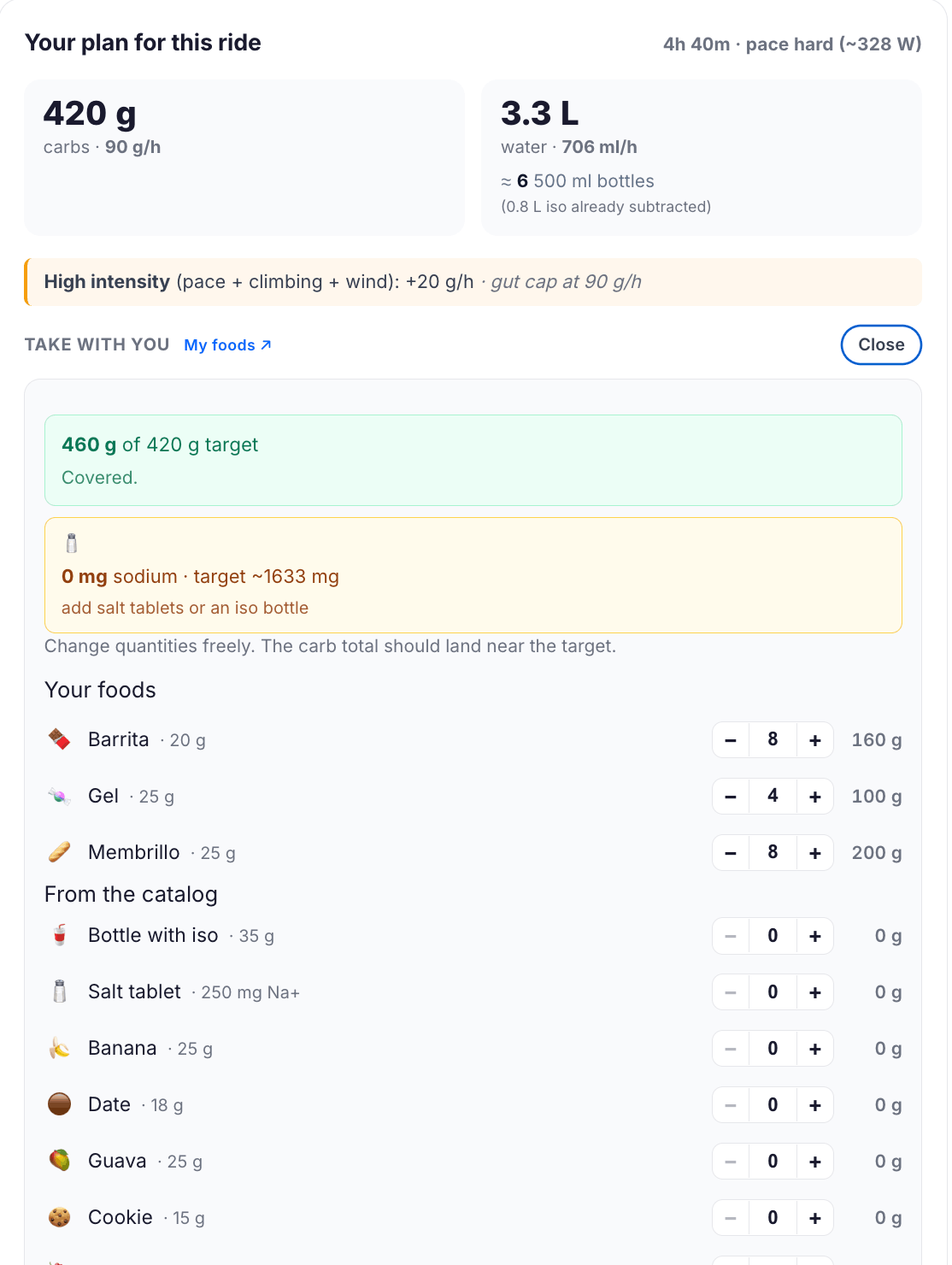
Work out when to eat and drink on your next ride based on real effort.
Plan your fuelling with Bidón →Energy gels for cycling, fast carbs when you need them
Gels are your quick carb supply. A typical packet holds 20 to 30 grams of fast carbohydrate in something you can stuff in a jersey pocket. They digest quickly because they are mostly simple sugars, glucose, maltodextrin or fructose, with almost no fibre.
When a gel makes sense.
- On climbs or hard efforts when you need energy fast.
- Approaching hour two or three of a ride, when you feel the glycogen dip coming.
- In the final 30 minutes of a race or a tough session.
- On rides past two hours at threshold or above.
Most gels work best chased with water or an electrolyte drink. The water moves the carbs into your small intestine faster, which is where they get absorbed. GU, Hammer Gel and Maurten are reliable staples. Single ingredient options like maple syrup or honey based products exist and they work, though they are not built for rapid absorption under hard effort.
One thing worth knowing. Gels taste better when you are warm and moving. What feels like icing at room temperature goes down easily on a hot climb.
Energy bars for cycling, sustained fuel you can carry
Bars are the steady state option. Unlike gels they have texture and usually some fat, protein and fibre. That means slower digestion and more stable blood glucose, with less of the spike and crash you can get from a gel.
When a bar makes sense.
- On steady paced rides, long and below threshold.
- When you want fuel that lasts 45 to 60 minutes in your system.
- As part of a rotation on a longer ride, alternating bars and gels.
- Early in a ride, when the effort is controlled.
Clif Bar, SIS Go Energy Bar and Torq Bar are the usual suspects. Plenty of riders mix carb heavy bars, 60 grams or more with minimal fibre, alongside bars that sit lighter in the stomach with more balanced macros. The point is to keep intake steady without upsetting your gut. Most riders handle a bar every 45 to 90 minutes depending on pace and conditions.
Energy bars vs gels vs chews for cycling
This is the question that matters once you have both in your pocket. The three formats carry a similar job but they do not behave the same in your stomach or in your hands.
| Format | Carbs per unit | How fast it lands | How it sits | Eating it while moving | Where it fits |
|---|---|---|---|---|---|
| Gel | 21 to 25 g per sachet | Fast. Mostly simple sugars with almost no fibre or fat | Light, but the sweetness stacks up if you chain several | Easiest. One hand, no chewing, no wrapper to fold | Climbs, hard efforts, the last hour |
| Bar | 26 to 38 g per bar | Slower. Texture, and usually some fat and protein | Fills you up, which on a five hour ride is a feature | Needs chewing and a free hand. Awkward above threshold | Steady stretches, early in the ride, flat roads |
| Chews | About 31 g per packet, split into pieces | Fast, close to a gel | Lighter than a bar, less cloying than a gel | Good, and you can take one piece at a time | When you want small doses spread out |
The practical rule I use is simple. On a climb, a gel, because chewing while breathing hard does not work. On the flat, a bar, because there is time and it holds you longer. Chews when I want to drip feed rather than commit to a whole thing. And at the end of a long day, whatever I can still face, which is rarely what I planned in the kitchen.
What decides it is not the format but the total. Thirty to sixty grams of carbohydrate an hour past 90 minutes, pushing towards ninety on long hard days once your gut is trained for it. Three gels, two bars or a mix all get you there. Pick what you can actually swallow at the effort you will be riding.
How the big energy gel and bar brands compare
Every figure below comes from each maker's own nutrition page, checked in September 2026. Formulations change and flavours differ inside the same range, so treat these as the published numbers for one reference product, not as a league table.
| Product | Format | Carbs | What the label says |
|---|---|---|---|
| GU Original Energy Gel | Gel | 21 to 23 g | Maltodextrin and fructose, 60 to 125 mg sodium, 450 mg amino acids. Caffeine in many flavours, 20 or 40 mg |
| Maurten GEL 100 | Gel | 25 g in a 40 g sachet | Glucose to fructose 0.8 to 1, hydrogel carrier. The CAF version adds 100 mg caffeine |
| SiS GO Isotonic Energy Gel | Gel, 60 ml | 22 g | Maltodextrin only, isotonic, designed to go down without extra water |
| Hammer Gel | Gel | 21 to 22 g | Maltodextrin based, no added refined sugars, four amino acids. Caffeine in two flavours, 25 and 50 mg |
| Tailwind Endurance Fuel | Drink mix powder | Not published on the product page | Not a gel. It goes in the bottle and replaces both drink and food. Caffeinated flavours exist |
| CLIF BLOKS | Chews | 31 g per 4 pieces | 126 kcal and 15 g sugars per 4 pieces on the EU label. Caffeine in some flavours |
| TORQ Bar | Bar, 45 g | 30 g | 2 to 1 maltodextrin and fructose, and only 1 g of fat, which is what keeps it quick to clear |
| SiS GO Energy Bar Mini | Bar, 40 g | 26 g | 4.5 g protein and 2 g fat. Small enough to finish in two bites |
| CLIF BAR Chocolate Chip | Bar, 68 g | 38 g | 258 kcal, 18 g sugars, 5.4 g fibre, 10 g protein, 6.1 g fat. The biggest carb load here, and the one that fills you most |
Two things jump out when you line them up. Gels cluster tightly, 21 to 25 g, so choosing between them is about texture, caffeine and what your stomach likes, not about the carbohydrate. Bars spread much wider, 26 to 38 g, and the fat column explains the difference in how they feel: one gram in the TORQ against six in the CLIF BAR.
Why a supermarket bar is not a cycling energy bar
KIND, RXBAR and Lärabar come up a lot in cycling searches, and they are good food. They are just built for a different job. Put the labels side by side and it shows.
| Bar | Weight | Carbs | Fibre | Fat | Protein |
|---|---|---|---|---|---|
| TORQ Bar, built for riding | 45 g | 30 g | Not stated | 1 g | Not stated |
| CLIF BAR Chocolate Chip | 68 g | 38 g | 5.4 g | 6.1 g | 10 g |
| Lärabar Cherry Pie | 48 g | 28 g | 4 g | 8 g | 4 g |
| KIND Dark Chocolate Nuts and Sea Salt | 40 g | 16 g | 7 g | 15 g | 6 g |
The KIND bar carries roughly half the carbohydrate of the TORQ in a similar sized package, with fifteen grams of fat and seven of fibre against one gram of fat. Fat, fibre and protein all slow how fast the stomach empties, which is exactly what you want in a bar you eat at your desk and exactly what you do not want at 85 per cent of threshold. Lärabar sits in between, with three ingredients and real carbohydrate, though twenty of its twenty eight grams are sugars from dates.
RXBAR I could not put in the table. Their site blocks automated reading, so I have no label figures I can stand behind. What their own pages do say is that the bars are built on dates, egg whites and nuts and sold as a protein bar, which tells you the same story as the others in this group.
None of this makes them a bad choice. A Lärabar at kilometre 30 of a steady ride is fine, and a KIND bar in your back pocket is better than nothing at all. But if you are choosing what to carry for a hard four hour day, a bar designed for it gives you more carbohydrate and less of everything that slows it down, and that is the whole point of the category.
How to build a cycling nutrition strategy that works
The best bars and gels for your rides are not universal. What your stomach tolerates depends on effort, temperature and habit. A sensible starting point is 30 to 60 grams of carbohydrate per hour on rides over 90 minutes, pushing towards 90 on long hard days once your gut is used to it. On a steep climb you might want a gel, on a valley road a bar feels less rushed.
Test your fuel on training rides first. A gel that tastes fine in your kitchen tastes different at mile 80 with a headwind. Digestive trouble ruins more long rides than punctures do. Most cyclists land on their own mix, a gel at mile 40 and 80 and a bar at mile 60 for instance, through trial and error.
Hydration goes hand in hand with fuelling. Gels want water, bars tolerate sports drink.
Keep reading about nutrition for cyclists.