
Best Time to Ride: Wind and Hour Guide (Bike)
Every cyclist knows some days feel harder than others. Wind speed and time of day shape your effort. Learn how to time your rides for real performance gains.
You plan a 100 km ride for Thursday. Same route, same effort, but the day before, wind quietly knocked 20 minutes off your pace. Why? The weather shifted, and your timing was different. The best time to ride your bike in wind isn't about comfort, it's about matching your effort to the conditions you'll actually face. Wind changes hour by hour, not just day by day, and once you understand that rhythm you can schedule rides when the air works with you instead of against you. Here's how to find the best time of day to ride in wind, and how to plan around it.
See the wind at every kilometre of your next ride, before you leave.
Plan your route with MoguWind →Why Wind Direction Matters More Than Wind Speed
Most riders fixate on headwind speed. A 20 km/h headwind stings, so it feels like the whole story. But direction is the real story. A morning wind from the northeast is harmless if your route heads southwest. The same afternoon wind, from the same direction, becomes a wall the moment you turn for home. Wind doesn't blow uniformly from dawn to dusk either. It shifts with air pressure systems, thermal activity, and local geography.
A 15 km/h headwind adds roughly 30% to your aerobic effort on flat terrain. Crosswinds demand balance and concentration, raising fatigue even when they don't slow you much. Tailwinds feel free, but they're rare gifts. Most cyclists pick a route and then fight whatever wind is already there. The smarter move is to plan for the wind that will be there, which is exactly why timing matters so much.
How Wind Changes Through the Day
Wind follows fairly predictable daily rhythms, and knowing them is the foundation for choosing the best time to ride your bike in wind.
- Early morning (5 to 7 am). Often calm or very light. The air is stable and cool, so mountain passes, coastal roads, and exposed routes are at their kindest.
- Late morning (9 to 11 am). The sun heats the ground unevenly and thermal winds start to build steadily.
- Midday (11 am to 3 pm). Wind peaks from this thermal mechanism alone, even before any larger weather system pushes in.
- Afternoon (3 to 6 pm). Stays brisk, because the ground is at its warmest.
- Evening (6 to 8 pm). Often drops as the sun weakens and the air stabilises again.
- Night. Depends on the weather system in play, not on the sun.
These aren't rules, they're tendencies. A storm system overrides the daily thermal cycle entirely. But on stable days, early mornings and late evenings are your calm windows, and that's where the best conditions usually hide.
The Best Time to Ride Your Bike in Wind, by Goal
There isn't one best time to ride a bike in windy conditions. It depends on what the ride is for.
If you're chasing a personal best on a hilly route, morning rides give you the best odds. Lower wind speed means fewer energy leaks to lateral movement and braking resistance, so your watts go into climbing rather than fighting gusts. It's the same reason gran fondos and mass participation rides start at dawn. Wind is weakest, and cooler air helps thermoregulation.
For endurance and base-building, afternoon wind matters less. You're not racing the clock. A steady 15 km/h headwind on a two-hour spin builds aerobic fitness and mental toughness, and plenty of riders seek out wind deliberately for that reason. The engine gets stronger. But if you're tired, or the route is already hard with steep climbs and technical sections, afternoon wind can turn a workout into a slog.
Recovery rides are almost pointless in strong wind. You can't stay genuinely easy when you're fighting gusts, so these belong in calm windows. Early morning, late evening, or right after a cold front passes and the wind drops.
Time Your Route to Dodge the Headwind
Route direction and time of day interact. If your local prevailing wind is westerly, a ride heading west in the morning might be a tailwind, but the same road heading east in the afternoon becomes a headwind nightmare. Many cyclists build loops so the hardest section, the steepest climb or the most exposed terrain, falls when wind is calmest. That takes planning and knowing your wind rose, the distribution of wind direction over the months.
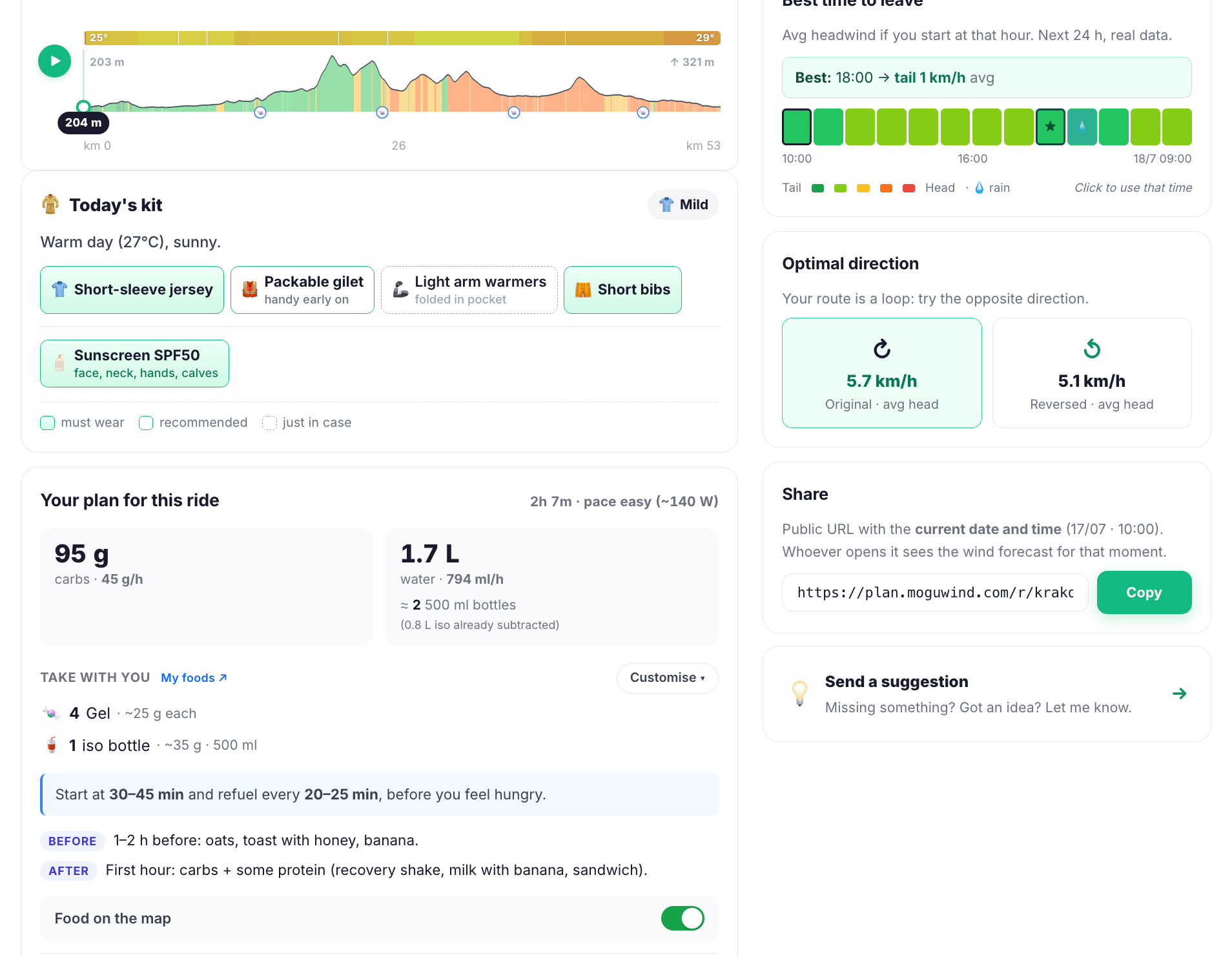
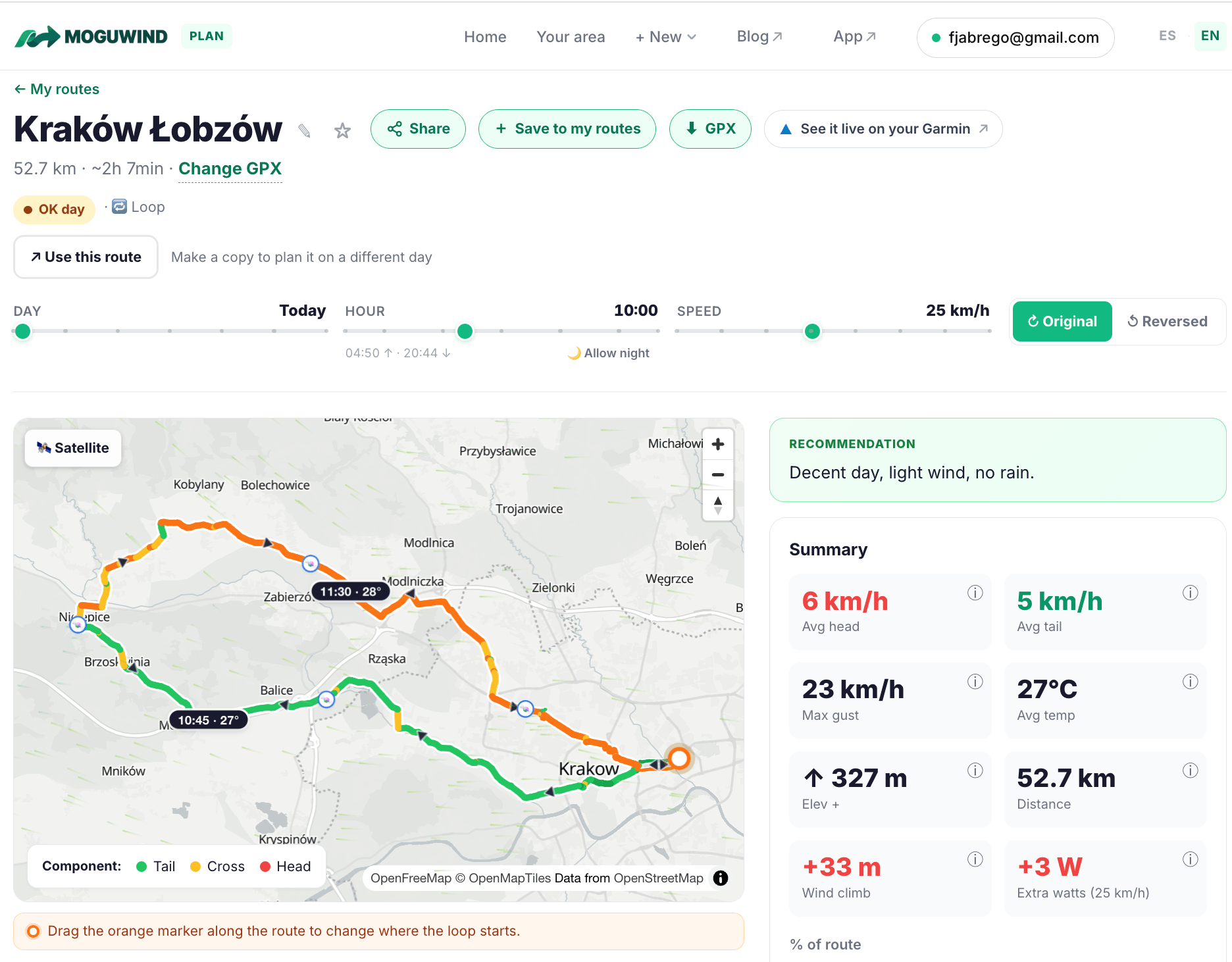
Better still, use a wind forecast built for cycling. Generic weather apps show average wind at a single location. MoguWind Plan calculates the wind at each kilometre of your route, at the exact time you'll ride it. You see speed and direction segment by segment, not one number for the whole day. Wind can swing direction within 20 km on hilly terrain, and your start time changes everything. The route planner even lets you test the same route at three different departure times and watch how the difficulty shifts before you leave.
See the wind at every kilometre of your next ride, before you leave.
Plan your route with MoguWind →Daylight, Energy, and When to Eat
Wind isn't the only thing that shifts with the clock. Daylight, temperature, and glycogen stores all move too. Morning rides start with fuller glycogen after sleep, but a lower core temperature. Afternoon rides use warmed-up muscles but more depleted fuel. Winter mornings are dark; summer evenings stay bright for hours.
For most recreational cyclists, the sweet spot is 6 to 8 am. Low wind, full glycogen, cool enough not to overheat, and enough daylight to ride safely. The second-best window is 5 to 7 pm, with the evening sun still strong, the air often calming as the thermal cycle weakens, and muscles warm from the day. Midday, from 11 am to 2 pm, is usually the worst, with peak wind, peak heat, and the highest fatigue risk on long routes.
Timing also changes how much you need to eat. A windy afternoon ride burns significantly more than a calm morning one over the same distance. When you check a route's wind profile in MoguWind Plan, it also flags where energy demand peaks, so you know to eat before the hard section hits, not after. And if you ride with a Garmin, Bidón takes that plan onto your head unit and sends eat and drink alerts at the right moments during the ride, adjusted for your actual effort.
Get real-time eat and drink alerts on your Garmin, adjusted to your effort. Free, and it installs in two minutes.
Get Bidón for Garmin →A Week of Riding, Match the Workout to the Wind
Over a week, you're managing a portfolio of workouts, from hard sessions to long rides, recovery, and speed work. The best time to ride your bike in wind depends on which one you're doing.
- Hard intervals and hill repeats. Early morning (6 to 7 am). Wind lowest, effort cleanest.
- Long, steady rides. Morning or early evening. Route choice matters more than the exact hour.
- Endurance in wind. Afternoon, on purpose. Build toughness and train the engine to work harder.
- Recovery rides. Calm windows only. Early morning or just after a cold front.
- Commutes and casual spins. Any time. Just accept the weather.
None of this means skipping rides when it's blowing. It means matching the workout to the conditions. A gusty Thursday afternoon isn't a bad day to ride, it's a day for steady aerobic work or tempo efforts that tolerate wind. Save the hard 20-minute effort for a calm Tuesday dawn.
The Real Edge, Micro-Timing
Forecasts aren't perfect. But knowing that wind shifts from hour to hour, not just day to day, gives you an edge. If your Tuesday session is a hard 90-minute ride, going out at 6 am instead of 5 pm can mean roughly 5 km/h less wind, for nothing but a change of alarm. That's meaningfully less fighting, the same fitness gain, and a far better feel.
Over a training block, those micro-gains compound. Thirty hard sessions with less wind resistance means more power reaching the road and less energy wasted. Your times improve not because you got stronger overnight, but because you rode smarter. It's why pro teams scout calm mornings for key sessions and schedule hard blocks in stable weather windows.
Check the forecast the night before. If a shift favours your ride, move it by an hour or two. Test your route on MoguWind Plan at three times, your preferred slot, one hour earlier, and one hour later, and see where the wind is lowest. That's your window.
What Actually Matters
Riding consistently beats waiting for perfect conditions every time. A windy Thursday ride is worth ten no-shows spent hoping for a calm Saturday. But if you have the flexibility, timing matters. Test it for a month. Schedule hard workouts in early-morning calm windows, keep recovery rides truly easy by avoiding the windy hours, and log how you feel.
Most riders find morning rides are faster, feel better, and come with less mental friction. Whether that's the wind, the glycogen, the temperature, or just the ritual, the effect is real. Start early, ride smart, and use a forecast that shows you wind segment by segment rather than a single daily number. Your times will follow.
Two free tools, one goal. Plan the route, then let your Garmin call the shots on the road.
Plan your route → Get MoguWind for Garmin →Keep reading about planning routes with wind.