
Headwind, Tailwind vs Crosswind in Cycling: How MoguWind Shows It
Wind direction changes everything on the bike. Headwind slows you down, tailwind speeds you up, and crosswind throws you sideways. Learn what each does and how MoguWind displays it segment by segment.
Wind is the invisible variable that decides whether your 100 km ride feels like a cruise or a slog. Most cyclists treat it as a single number. "It will be 15 km/h today." That is the problem. Headwind, tailwind and crosswind do not just differ in speed. They differ in how they wreck or help your effort. MoguWind breaks that down for every segment of your route, so you know what you are riding into before you leave home. Here is how it works.
Why Wind Direction Matters More Than Wind Speed
A 20 km/h headwind and a 20 km/h tailwind are not opposites in effort. They are not even close. Aerodynamic drag rises steeply with speed, so the maths is not symmetric. A headwind can cut your speed by roughly 30%, while the same wind behind you only gives back around 15 to 20%. You pay the air tax unevenly, and it is never in your favour.
Crosswind is its own beast. It does not slow you the way a headwind does, but it makes you steer non stop. On a narrow road or in a bunch that means tension, focus and energy spent fighting the drift. Some riders find a crosswind more tiring than a headwind, because you cannot just push harder. You have to hold the bike straight the whole time.
Strava records your effort, but it does not tell you the wind broke you down segment by segment. The MoguWind web planner maps the wind direction and strength for each kilometre of your route, so you can see exactly where the hard bits are.
Headwind, the Aerodynamic Wall
A headwind is a straight hit to aerodynamic drag. Every watt you make goes into pushing air aside instead of moving you forward. On the flat you feel it at once. Your speed drops, your heart rate climbs and time stretches out.
- Effect on speed. A 15 km/h headwind can cost 20 to 30% of your speed on the flat, depending on your position and bike.
- On climbs. Mild on steep ramps, where the gradient rules, but miserable on rolling terrain where you would normally carry momentum.
- Pacing. Ease the intensity a touch and hold steady power instead of chasing speed. Your heart rate will spike if you fight it.
- In a group. Drafting saves you a good chunk of the effort, as long as you are not the one on the front.
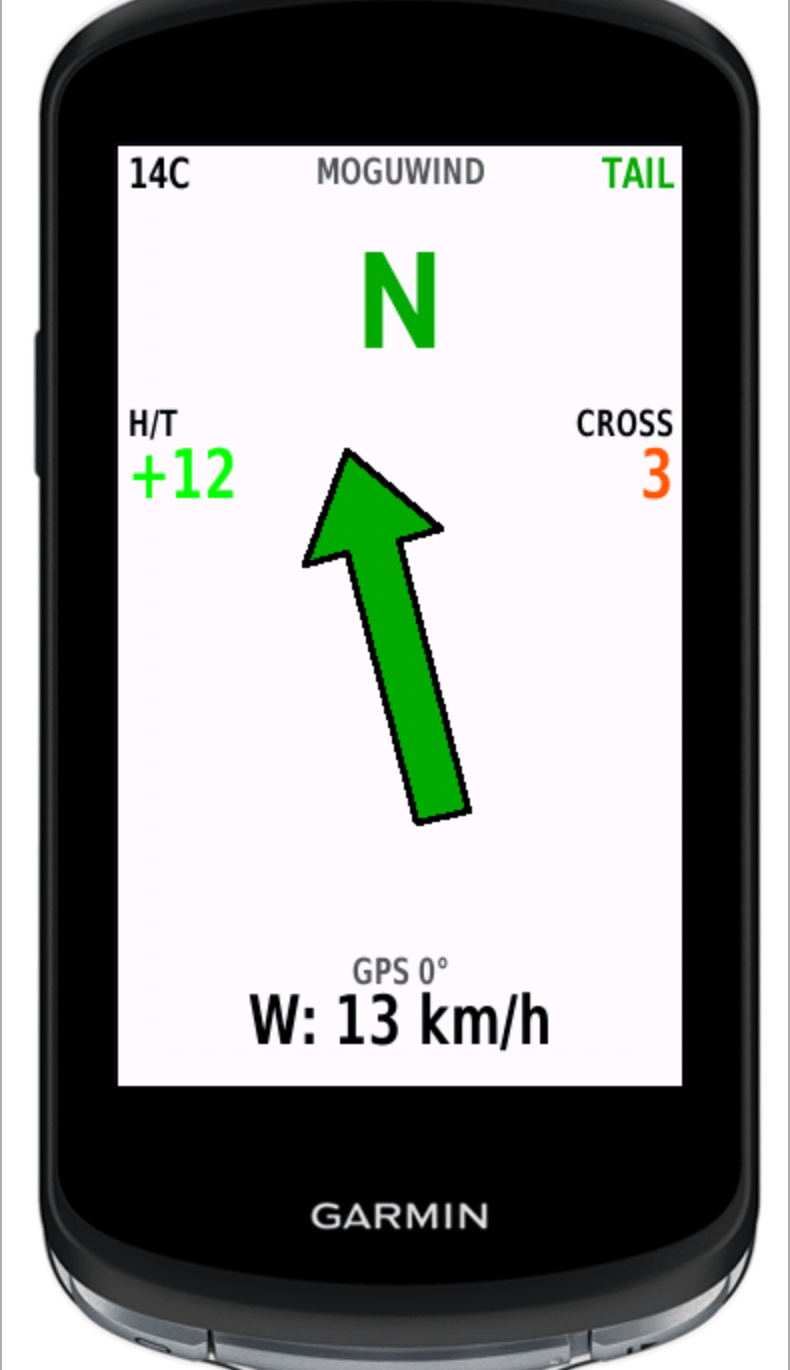
In the MoguWind app for Garmin, headwind shows on the arrow in red, so you see it coming and can settle your pacing from the section before.
Tailwind, the Speed Bonus That Is Not Quite
A tailwind feels like cheating. Your speed climbs, the watts feel lighter and you float along. Here is the catch. You are not doing less work. The wind is doing the work for you. So the fitness gain is smaller, and if you chase the speed you will burn matches you need later.
- Real speed gain. A 15 km/h tailwind adds maybe 10 to 15% to your speed, less than the headwind takes on the other side.
- How it feels. Easier, because you go faster for the same power, even though your engine is working about the same.
- The trap. It is easy to go too hard on a tailwind. Stick to your power target, not your speed.
- Rolling terrain. A tailwind helps you carry speed through the dips, so rolling roads feel smooth.
MoguWind shows tailwind on the arrow in green, so you can spot it early and plan where to push and where to save.
Crosswind, the Steering Tax
A crosswind does not change your speed as much as a headwind, but it asks for constant small corrections. On a 100 km ride with a steady crosswind, that is 100 km of steering. Your core, shoulders and grip tire before your legs do.
- Energy cost. Roughly 10 to 15% more than calm conditions, even on the flat. It is not aerodynamic, it is neuromuscular fatigue.
- Handling. Narrow roads and higher speeds make it worse. A fast descent with a strong crosswind is demanding.
- In a group. A crosswind splinters the bunch. Single file lines break up and the pace turns ragged.
- Your bike. Lighter wheels and deeper rims feel the push more. It is something to respect on an exposed day.
In the app the crosswind shows on the arrow in amber. That matters for planning. If your route has a crosswind stretch on a narrow or technical road, you might want to change it or pick another day.
See the wind at every kilometre of your next ride, before you leave.
Plan your route with MoguWind →How MoguWind Breaks It Down for You
Most weather apps give you one number. "Wind 15 km/h." MoguWind shows you the part that matters for your route, the wind relative to your direction of travel. That is the difference between knowing the forecast and knowing your ride.
When you enter a route into the MoguWind planner, it works out the wind speed and direction for each kilometre at the exact time you will be there. On a four hour ride the wind shifts, builds and drops. MoguWind follows all of it, segment by segment.
For each stretch you can see the wind speed and direction relative to your route, whether it is a headwind, a tailwind or a crosswind, and where the hard sections land. That is the data Strava does not have and Windy cannot give you for your route. Windy shows global wind maps. MoguWind shows how the wind hits your kilometres. So headwind, tailwind, crosswind while cycling, how to detect them all?.
Plan Your Ride Around the Wind, Not the Other Way Around
Once you know where the headwind, tailwind and crosswind fall on your route, you can make real decisions.
- Timing. If the headwind lands on the second half, start early while the wind is lighter.
- Pacing. Save energy for the headwind sections and use the tailwind to recover, not to go faster.
- Route choice. Swap a crosswind stretch for a more sheltered road.
- Your group. Warn your mates about a headwind climb and they will pace it differently.
MoguWind is not just a forecast. It is a tactical tool. You are not riding blind any more.
See the wind kilometre by kilometre on your route before you leave home.
Plan your route with MoguWind →Keep reading about planning routes with wind.