
Don Quixote bike route: cycle Spain's literary adventure
The Don Quixote cycling route across La Mancha combines literary pilgrimage with demanding terrain. Here's how to ride it smart and where wind plays a decisive role.
The Don Quixote bike route is not a single marked trail. It is a challenge across the windswept plains of La Mancha, in central Spain, retracing the fictional knight's journey. The cyclists who ride it are not just chasing kilometres. They are riding through Cervantes' masterpiece. The catch is that this flat, exposed terrain becomes a very different ride depending on the wind and the timing. Unlike a Strava segment, the conditions change a lot hour by hour and day by day. That is why planning matters.
What Makes the Don Quixote Route Special for Cyclists
La Mancha is brutally honest cycling terrain. The land is relentlessly flat, perfect for speed and punishing in the open. There are no foothills to block the wind and no forest cover to give you shelter. You are exposed, which is a thrill on a tailwind day and a grind on the other kind.
The route follows the arc of Cervantes' novel across towns that read like a chapter list. El Toboso, where Dulcinea supposedly lived. Campo de Criptana and Consuegra, with their white hilltop windmills that inspired the famous giants scene. Argamasilla de Alba, which claims to be where Quixote was born and imprisoned. Each stop adds context you do not get from a guidebook. You are covering ground on a bike that Cervantes covered on foot, and that gap of centuries closes fast when you are staring at the same horizon.
You are covering ground on a bike that Cervantes covered on foot, and the centuries close fast when you stare at the same horizon.
Most routes run between 350 and 500 km depending on your detours and how many cultural stops you add. A continuous loop from Ciudad Real or Toledo usually takes four to seven days at 60 to 100 km a day, which is manageable without elite fitness as long as you respect the conditions.
Terrain and Wind, the Real Challenge
La Mancha looks simple on a map. Flat, straight roads, barely any elevation. But the wind is the variable that runs the show, and it changes everything. The plains funnel the north to south airflow into a constant presence. Summer winds are often strong but predictable. Autumn and spring bring more erratic patterns that can flip mid ride.
Beyond the wind, the terrain breaks down like this.
- Road quality. A mix of minor national roads with decent asphalt and local roads that are rougher but rideable. The main N roads carry traffic, so the quieter secondary routes are usually worth the small detour.
- Elevation. Almost none. La Mancha sits around 600 to 700 metres with no sustained climbs. Your engine matters far less than aerodynamics and wind management. A fit rider who ignores the wind can finish a day more depleted than a less fit rider who planned around it.
- Navigation. Straightforward if you follow a prepared GPS route. There are few obvious landmarks between towns, and one long straight road looks a lot like another.
- Water and supplies. Towns are spaced 20 to 50 km apart. Carry extra capacity and plan your stops on purpose. Summer heat plus sustained effort in dry air empties your bottles faster than you would expect for the same distance elsewhere.
A fit rider who ignores the wind can finish a day more depleted than a less fit rider who planned around it.
The literary angle is not decoration, it is useful. La Mancha is genuinely sparse and austere, and riding through it you understand why Cervantes chose it. The emptiness amplifies Quixote's delusion, and on the bike you feel it too. The isolation, the relentlessness, the way a 20 km/h headwind can humble you on open ground with no shelter for the next 15 km. The landscape makes the book make sense.
Wind Timing and Route Planning
Here is where most cyclists get the Don Quixote route wrong. They book a week and hope. Late spring, May to early June, and autumn, September to October, give you the best thermal stability, with fewer extreme wind days and steadier patterns through the day. Summer is doable but exposed. Winter crossings are for a specific kind of masochist.
On the north to south sections, a northeasterly wind, typical in spring and autumn, gives you either a steady push or a headwind depending on your direction. The east to west stretches are where you feel most exposed. There is little natural shelter and the wind hits you square.
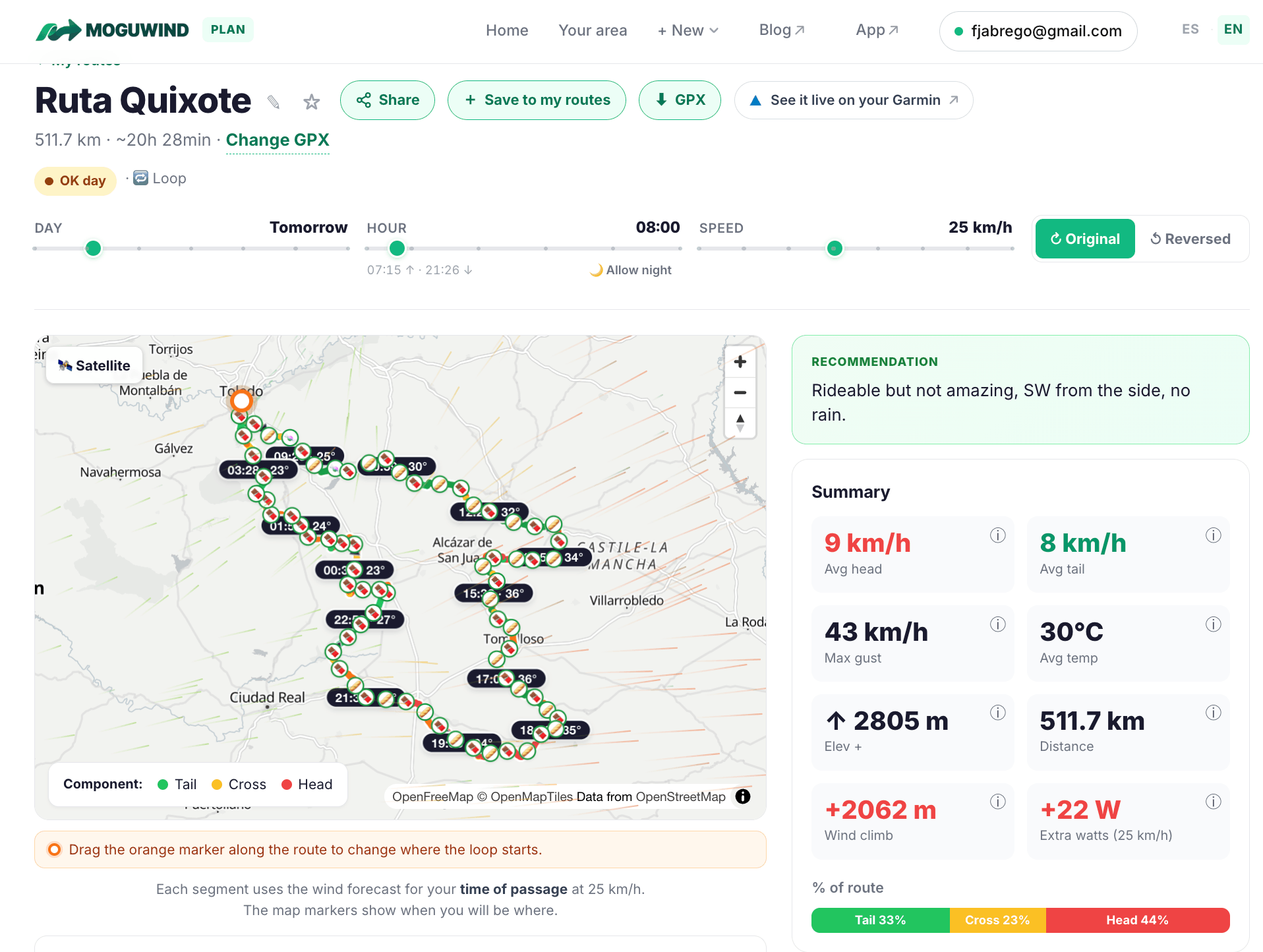
Plan with real wind data, not just the temperature or a general forecast. This is where MoguWind Plan changes how you prepare. I built the whole route in it, so you can just open the Don Quixote route here and see the wind at every kilometre, set for an 8am start. You see exactly where that northeasterly turns into a crosswind or a headwind, and how the time of day shifts the picture. Instead of guessing, you know. Kilometres 40 to 60 will be 15 km/h in your face. Kilometres 80 to 100 turn in your favour. That lets you set your pace, your fuelling and your head before you leave.
Instead of guessing, you know. Kilometres 40 to 60 in your face, kilometres 80 to 100 in your favour.
See the wind at every kilometre of the Don Quixote route before you leave.
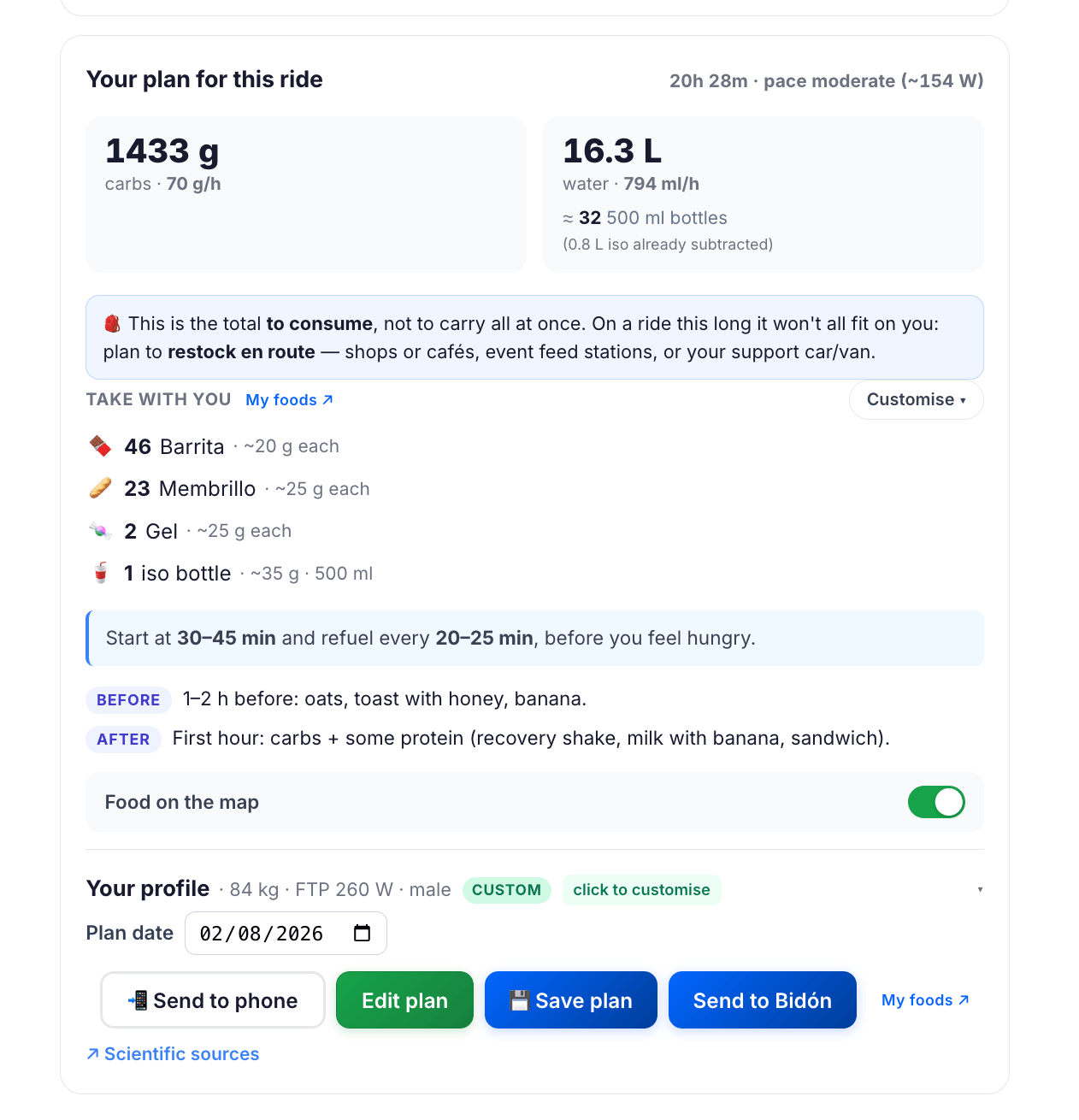
Open the Don Quixote route in MoguWind →The planner also works out when and how much to eat from the real effort each segment demands, taking the wind load into account, not just the kilometres. On a route like this, where the flat ground tricks you into underestimating the cost of a long headwind, that guidance is worth listening to. And if you ride with a Garmin Edge, Bidón puts it into practice on the road. It is a free data field that tells you when to eat and when to drink in real time, so you are not doing sums on the bike or forgetting to fuel until it is too late. Think of it as your nutritionist on the handlebar.
Free on Garmin Edge. It tells you when to eat and drink in real time, so you never bonk on the plains.
Get Bidón for Garmin →If you want the wind live as well, the MoguWind app does that in real time. You see the wind direction and strength for your exact position as you move. On featureless terrain, where a 5 km/h shift in the apparent wind changes how hard it feels, having that readout on your head unit is genuinely useful, not a gadget extra.
Logistics and Cycling Culture
Most cyclists tackle the Don Quixote route on their own or with light support. There is no established cycling infrastructure the way there is on the Camino de Santiago, and very few organised packages. That freedom is both the appeal and the challenge.
Accommodation. The small towns along the way have modest hotels and casas rurales. Book ahead, especially in May, June and September. Wild camping is possible in places, but formal sites are sparse, and rolling into a town after dark with no room booked is stress you can avoid.
Bikes and gear. A gravel or all road bike is the most comfortable choice. Road bikes are fine on the main routes, but you will meet rougher surfaces on the scenic alternatives. Carry repair kit, because bike shops are rare between towns and a mechanical in the middle of La Mancha is a long wait for a fix.
Support. The route is entirely doable solo with your beds booked ahead and resupply in the towns. Some riders add a rest day in Consuegra or Campo de Criptana to see the windmills and decompress. You do not have to ride it as a race. Mixing riding days with short cultural stops is how most people get the most out of it.
You do not have to ride it as a race. That freedom is both the appeal and the challenge.
Making It Literary
The Don Quixote route is for riders who want more than kilometres. If you are going to ride it, spend some time with the novel first, or at least read the key scenes you will be passing. Visit the actual sites. The windmills, the inn at Puerto Lápice, the museums in Argamasilla. Understand why Cervantes put his deluded knight in this exact landscape. The irony deepens when you are riding into a real headwind on the open plains and feeling, very literally, what the terrain does to you. The delusion and the romance hit you in the same moment.
The best Don Quixote ride is not measured in average speed or total elevation. It is about riding through a landscape that existed four centuries before cycling did.
Plan Properly, Then Ride
The Don Quixote route is within reach for any cyclist with reasonable fitness and enough time to spread the kilometres sensibly. It is not extreme, but it demands respect for the conditions. Wind, heat and isolation are real, and they will define your experience more than the road surface or the gradient.
Check the wind before you commit to dates. Use a proper route planner to see how the conditions play out kilometre by kilometre before you leave, not while you are standing in a headwind wondering where the next town is. Bring enough water. And bring some curiosity. La Mancha rewards the cyclists who understand what they are riding through.
Build your own version and see the wind at every kilometre before you leave.
Plan your route with MoguWind →Keep reading about planning routes with wind.