
Nutrition Calculator for Cycling Routes: Carbs, Water, Sodium
Know exactly how many carbs, litres of water, and sodium you need before you ride. MoguWind Plan calculates your route's nutrition demands kilometre by kilometre.
Most cyclists ask the same thing before a long ride. How much should I eat and drink? The answer is not on your Strava map. You need a nutrition calculator for cycling routes that takes in the gradient, the wind and the duration. Without it you either carry too much, which is heavy and uncomfortable, or too little, which ends in a bonk. This article shows you how to work out your real needs, and how Bidón puts that plan into practice on the bike so you never have to do sums at kilometre 85.
Why Route Nutrition Calculation Matters
A flat 100 km route burns fewer calories than a mountainous 100 km route. A headwind adds 15 to 25% more effort. Yet most cyclists pack the same snacks whatever the day. That is like fuelling a car for a motorway cruise and then driving it uphill for four hours.
The science is well established. Around 30 to 90 g of carbohydrate an hour keeps you going on rides over 90 minutes, with 90 as the practical ceiling for a trained gut (Jeukendrup). Below that your muscles run low on glycogen and your focus fades. Too much and you risk gut trouble. Fluid and sodium needs depend on your sweat rate, the temperature and the intensity (ACSM), and all of those are tied straight to your route.
Packing the same snacks whatever the day is like fuelling a car for a cruise and then driving it uphill for four hours.
A nutrition calculator that factors in the gradient and the wind gives you the precision to get your fuelling right. No surprises late in the ride.
What variables matter in a cycling nutrition calculator
Before you calculate anything, know what drives your needs.
- Carbohydrate. Your main fuel for hard cycling. Aim for 30 to 90 g an hour depending on the length and intensity. Long rides over about two and a half hours can take 60 to 90 g an hour if your gut is trained for it.
- Fluid. Sweat rate varies with your fitness, the heat and the effort. A rough baseline is 450 to 900 ml an hour, toward the top end in heat or on long climbs.
- Sodium. Replaces the salt you sweat out. Typically 300 to 900 mg an hour. It matters on long, hot rides to keep your thirst working and to avoid hyponatremia, which is dangerously low blood sodium.
- Fat and protein. Secondary fuels. On rides over three hours, small amounts help settle your stomach and keep you feeling fed.
How the Route Changes Your Needs
A 100 km ride at sea level with 500 m of climbing needs different fuel from 100 km with 2,000 m. Here is why.
Elevation. Climbing pushes up your calorie burn, roughly 5 to 10% for every 100 m of gain. A hilly route burns more, so you need more carbohydrate and more fluid.
Wind. A headwind adds aerodynamic drag. Riding into a 20 km/h headwind can burn 15 to 25% more calories than calm air. This is where most nutrition calculators fail. They ignore the wind. MoguWind Plan works out the wind for every kilometre of your route and adjusts the calorie and carbohydrate estimate to match. You are not guessing. You are planning for the exact conditions you will face.
Temperature. Hot rides raise your sweat rate and your sodium loss. A 30°C route needs more fluid and more electrolytes than a 15°C route over the same distance.
Intensity. A hard tempo ride burns more than an easy spin. Your planned pace and the terrain tell you how hard the day will really be.
This is where most nutrition calculators fail. They ignore the wind.
How to apply nutrition calculations during your ride
A number is only useful if you act on it at the right moment, and mid ride, tired, with a climb coming, that is hard to judge. That is exactly what Bidón is for. It is a free Garmin Edge data field that tells you when to eat and when to drink, in real time, right on your screen. Two big boxes, EAT and DRINK, each with a countdown, and a full screen alert with vibration when it is time. A low beep for food, a high one for drink, so you know without even looking.
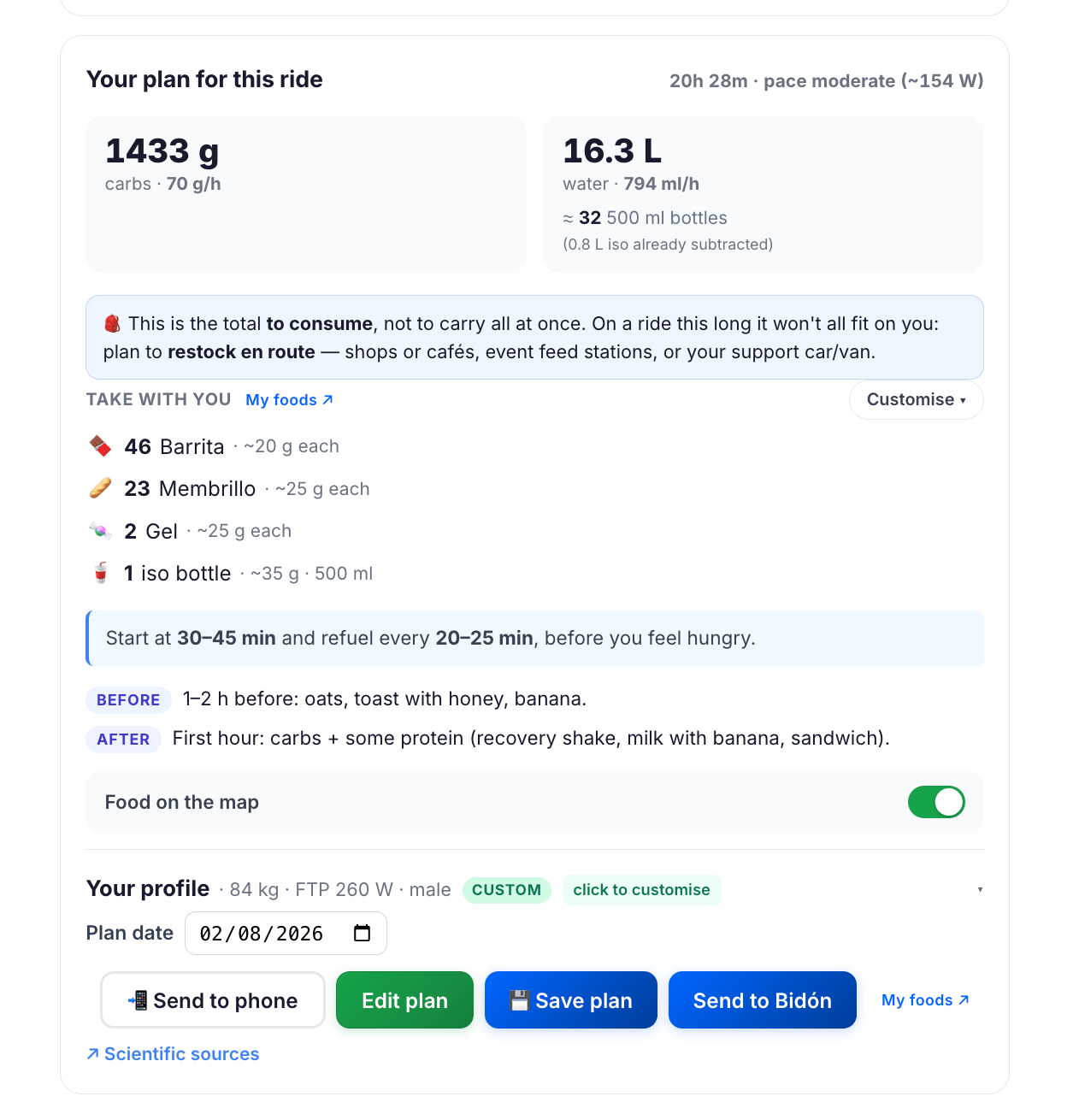
It works two ways. In Auto it does the maths on the fly from your ride duration, your intensity, the temperature and the bottles you are carrying, and scales the grams and millilitres to your real effort. Or you build a plan in MoguWind Plan with your own food, send it to the Edge once, and Bidón follows it. No plan that day? It just goes back to Auto. Think of it as your nutritionist on the handlebar, running on the same science as the numbers above.
Get an exact nutrition plan for your next ride, free.
Build your plan in Bidón →MoguWind Plan: calculating nutrition for your cycling route
The pre ride calculation lives in MoguWind Plan. Draw your route, upload it from Strava or open a saved one, and the planner shows the wind speed and direction for every kilometre at your estimated time of arrival. It then works out the total energy from the gradient, the wind and your weight, and turns that into carbohydrate, fluid and sodium targets you can hand straight to Bidón.
For example, if the planner estimates a four hour route will burn around 2,400 calories with moderate climbing and a 10 km/h average headwind, you might aim for roughly:
- Around 240 to 300 g of carbohydrate across the ride, up to 90 g an hour on the hardest stretches.
- 2 to 3 litres of fluid, near 500 to 750 ml an hour.
- 1,200 to 2,400 mg of sodium, around 300 to 600 mg an hour.
From there you pick real products you have tested. Two energy bars, a 500 ml sports drink and an electrolyte tab an hour, for instance. Real plan, real data. You can try it on a demo route, the Tourmalet and Hautacam example, then load your own and watch how the wind and the climbing reshape the plan.
See the wind at every kilometre and get your fuelling targets before you leave.
Plan your route with MoguWind →Common Nutrition Mistakes
Ignoring the wind. Strava does not show the wind per kilometre. Other planners treat wind as a general forecast rather than building it into route specific fuelling. Skip it and you will underestimate the effort on a headwind day.
Using generic calorie formulas. "200 calories an hour" is too blunt. A light climber on a hilly 50 km burns less than a heavier rider on the same road. A calculation tied to your weight and the terrain is far more accurate.
Assuming a steady effort. A 100 km sportive is not four hours of even pace. The first 30 km in a group, a harder middle, a fade at the end. Your fuelling should track that shape, not a flat line, which is exactly what Bidón's Auto mode does as the effort moves.
Forgetting sodium. Riders often cover carbohydrate and fluid and skip the salt. On rides over three or four hours, especially in heat, low sodium brings cramps, dizziness and a foggy head. Sodium is not optional. It is fuel chemistry.
Sodium is not optional. It is fuel chemistry.
And on the road, the MoguWind app puts the wind live on your Garmin screen.
Get MoguWind for Garmin →Simple fuelling strategy for longer cycling routes
- Plan your route. Load it into MoguWind Plan and note the elevation, the distance and the wind.
- Estimate the burn. Use the planner's energy estimate, adjusted up for climbing and headwind.
- Set your carbohydrate target. Turn the calories into grams and spread them across the hours, aiming for 30 to 90 g an hour by length and intensity.
- Choose your fuel. Pick real products you have tested in training. Bars, gels, drinks, rice cakes, they all work. Being consistent beats the brand.
- Pack fluid and salt. Carry a bit more fluid than you think, and add sodium through a sports drink, electrolyte tabs or real food.
- Let Bidón run it. On the bike, let the alerts tell you when to eat and drink so you are not counting in your head or forgetting on a descent.
A proper nutrition calculator for cycling routes takes out the guesswork and keeps you strong from the first kilometre to the finish. Factor in the wind, the climbing and the duration, not just the distance, and let Bidón handle the timing. You fuel smarter and you ride better.
Free on Garmin Edge. Your nutritionist on the handlebar, telling you when to eat and drink.
Get Bidón for Garmin →Install it free on your Garmin Edge from the Connect IQ Store.
Download Bidón for Garmin →Keep reading about nutrition for cyclists.